
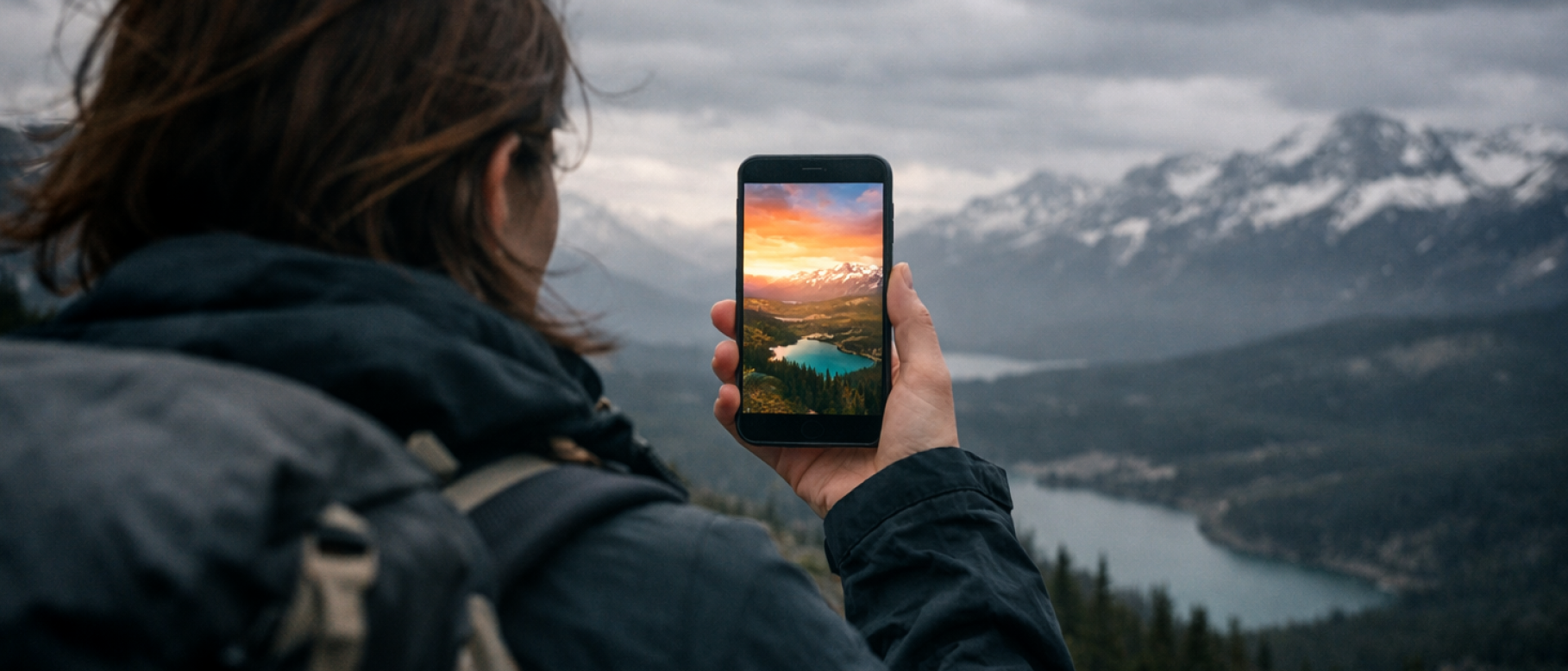
AI image generators can produce gorgeous travel “photography” in seconds. Golden-hour beaches with impossibly turquoise water. Mountain vistas where the light falls just so. A downtown streetscape that looks like it belongs in a glossy spread.
The images are beautiful. They’re also a trap.
Most DMOs aren’t using AI-generated imagery today. But the tools are getting better fast, and budgets aren’t getting any bigger. As AI becomes a default part of the marketing toolkit, the temptation to use it for destination photography will grow.
But before it does, it’s worth understanding what’s actually at stake.
AI imagery sets a visual expectation no destination can realistically deliver, at least not consistently. And in a business built on trust, any gap between what travelers see online and what they experience in person could turn your best marketing into your biggest liability.
AI Images Set Unrealistic Expectations You Can’t Take Back
The imagery you put in front of travelers does more than attract attention. It builds a mental model of what the experience will be like. The visuals become a cognitive benchmark. When they arrive, visitors are measuring reality against the images they’ve seen, whether they realize it or not.
Behavioral scientists Tversky and Kahneman call this the availability heuristic. The brain treats what it can easily picture as what it will probably get. At the same time, the behavioral economics principle of loss aversion tells us that people feel disappointment more intensely than they feel delight. That’s why it’s far better to exceed expectations than to fall short of them.
Consider the reverse. Last fall, I visited Asheville, North Carolina, for the first time and packed my bike for a ride in the Blue Ridge Mountains. I saw some photos beforehand. They were nice images, but they didn’t oversell the place. So when I got there, Asheville set its own bar: the charm of the town, the scale of the mountains, the experience of riding through them. Reality didn’t have to compete with a manufactured version of itself. It just had to show up. And it was more than enough.
That’s the position every DMO should want to be in.
Trust Is the Currency. AI Puts It at Risk.
A 2024 study by TUI Musement found that 82% of travelers worry AI content feels misleading or inauthentic. That skepticism is already baked in before they even see an ad with tricked-out AI images.
Most people can’t reliably tell the difference between AI-generated and real images. That sounds like it would make AI imagery safe to use. But it actually makes the problem worse. If your audience believes an image is real and later discovers it was generated without disclosure, trust erodes.
Unlike a bad review or a rainy weekend, the damage is entirely self-inflicted. You chose the imagery. You set the expectation. And once a traveler feels misled, that skepticism follows them into every future interaction with your brand.
Transparency is the only way to compensate. But even disclosed AI imagery carries risk, because the fundamental problem is the expectation gap. Even if a traveler knows an image is AI-generated, the visual still registers cognitively. It still sets a benchmark. Disclosure doesn’t undo the neurological effect.
AI Images Flatten Your Destination’s Unique Differentiators
There’s a subtler cost to using AI imagery that goes beyond trust. AI-generated imagery tends to homogenize destinations.
What makes a place feel different is exactly what AI erases. The specificity. The quirks. The way late-afternoon light hits a particular canyon wall for fifteen minutes a day during certain months of the year. A real photographer who waits for that moment captures something no AI can replicate, because AI doesn’t know what makes your destination unique.
Ansel Adams was famous for two things: his darkroom skill and his willingness to camp for a month until the light hit the rock face exactly right. That patience produced images no one else could because they captured moments that couldn’t be experienced anywhere else.
Your destination has unrepeatable moments like that. AI sands them down into something generic.
There’s a Right Way to Use AI With Your Imagery
AI itself is fine. It’s a tool, and like any tool, it has its place. The problem is using it to represent your physical destination as something it isn’t.
So where’s the line? We ran into this question after wildfires forced closures at the Grand Canyon. Unfortunately, visitation remained low even after parts of the park reopened. It was because people assumed the whole place was still closed. We had a messaging problem. So we created a video using real Grand Canyon photography with AI-generated “Now Open” signs (the kind you see in store windows) inserted into the scenes. The signage was obviously artificial and used to communicate a message.
That’s AI applied to graphic design and communication, not to misrepresenting the destination. Everyone understood those signs weren’t actually sitting on the rim of the Grand Canyon. Meanwhile, the real landscape was right there, unretouched, doing the actual selling.
The distinction is straightforward: use AI to communicate about your destination. Don’t use it to fabricate it.
Put AI Imagery Guidelines in Place Now
You may not be tempted to use AI imagery today. But budgets will get tighter. Tools will get better. New team members will join who grew up thinking AI-generated content is just how things work.
The time to set guidelines is before someone makes an honest mistake that costs your destination credibility. Formalize your AI imagery policy now. Make it part of onboarding. Spell out what’s acceptable (AI for design elements, compositing, messaging) and what isn’t (AI-generated representations of your actual destination).
Think of AI in your marketing like profanity. Used sparingly and with clear intention, it can land. Overused or pointed in the wrong direction, it undermines everything around it. AI for a clever “Now Open” graphic? That’s well-placed emphasis. AI to fabricate your destination’s scenery? That’s where you lose the room.